"If you instruct the brethren in these things, you will be a good minister of Jesus Christ, nourished in the words of faith and of the good doctrine which you have carefully followed. " - 1 Tim. 4:6
Thursday, September 16, 2021
Hope in Dystopia
Friday, May 7, 2021
Meek and Patient as a Sheathed Sword
The great Romantic poet William Wordsworth wrote many ecclesiastical sonnets, or poems regarding the church. One that affected me recently was titled, "Pastoral Character."
A genial hearth, a hospitable board,
And a refined rusticity, belong
To the neat mansion, where, his flock among,
The learned Pastor dwells, their watchful Lord.
Though meek and patient as a sheathed sword;
Though pride's least lurking thought appear a wrong
To human kind; though peace be on his tongue,
Gentleness in his heart--can earth afford
Such genuine state, pre-eminence so free,
As when, arrayed in Christ's authority,
He from the pulpit lifts his awful hand;
Conjures, implores, and labours all he can
For re-subjecting to divine command
The stubborn spirit of rebellious man?
He begins by expressing the living conditions, "A genial hearth, a hospital board," which show the parson as one who is generous and hospitable to others." He is a type of lord himself, whether or not he actually owns the title, he acts as one who watches over the health and good of those under his care. The picture of one mild-mannered is accurate, but Wordsworth is sure to declare that this man is no weakling, but whose meekness and patience resemble "a sheathed sword." That sword is unsheathed when he climbs the pulpit. He is "arrayed in Christ's authority" and tasked with the responsibility of, through Spirit-inspired words, "re-subjecting to divine command the stubborn spirit of rebellious man."
What a wonderful picture of the man of God!
Monday, May 3, 2021
Thoughts on Romanticism
As I’ve been reading and enjoying the English Romantic poets
recently, I thought I should dig deeper into the metaphysics of Romantic
poetry. This ties in with the appreciation for forms that undergird reality.
That which is real is the basis for what we see and experience.
The best of the Romantic poets and prose artists depict life
through the lens of imagination, which is the key to the Romantic mindset. Sometimes
they portray the best of the past and what we can learn from it, not always the
realistic version. Other times they portray the worst. They offer strong
critique of man’s disregard and corruption of nature and the consequences of
it, be it nominalism, industrialism, or the iconoclastic excesses of the
Reformation.
At its best it presents man in wholeness, mind, body, and
spirit. It portrays life as it should be, both internally and externally. The
consequences of excessive control are presented as harmful, whereas the good
that comes from living in harmony with nature is positive.
On the other hand, the anthropology of Romanticism is overly
optimistic. Believing that original sin is an outward problem that can be fixed
through natural means is faulty. The inward decay of man is at best neglected
and at worst contradicted. This stems from an overemphasis on man being made in
the image of God over and against the belief in man’s depravity. The
imaginative emphasis, so beautifully portrayed in authors like Walter Scott and
Coleridge, is taken to excess in one like Percy Shelley.
Another pitfall among the Romantics is idealism which leads
to ideology. The critique of one (bad) system while demanding implementation of
a (better) system will not lead to wise correction but militant overcorrection.
The example of Procrustes is appropriate here. The perfect ideal becomes the enemy
of the achievable, moderate correction. There is an inherent dualism in play
here. Romantics tend to divided the real from the ideal, focusing only on the
latter and neglecting the former.
The most significant problem with many Romantics is their
atheism. They begin with forms given by God by neglect the One who gave them in
the first place. For these atheists their religion is naturalistic pantheism;
their philosophy then has no real foundation, but the forms are solely their
own individual imaginations. To whatever the imagination is captivated by
natural law, reason, and the Creator, the results are truly beautiful. Once the
imagination is divorced these things, the result may be beautiful on the
surface but underneath is brutal.
Friday, April 23, 2021
New Podcast
Recently I began a new venture in the world of podcasting. I've been hesitant for a while, asking myself if we really need another person talking in cyberspace. But I think there is a need for yet one more podcast.
We are all submerged in the modern world to some extent. We can't and shouldn't try to abandon the world in which we live. Jesus did die for it, after all. If He immersed Himself in the daily matters that surrounded Him, ushering in God's kingdom, we should do likewise.
Slavery has always been a temptation. We understand how selling others into slavery is sin, but we don't understand the problem of giving yourself over to slavery. That's the wisdom of the doctrine of man's natural depravity. Not the straw-man version of depravity, but the realistic teaching that man naturally desires to rule himself rather than submit to God's rule. Ever since Adam and Eve, the serpent has presented the false-story of God-as-tyrant and ____?____-as-deliverer. These potential deliverers can all lead to slavery, whether bad things (drugs, ideology, communist dictators) or good things, e.g. technology, money, etc. A good life is about learning to walk free from the slavery of sin and become a faithful member of God's kingdom.
In this podcast we'll talk to people who understand different aspects of living a good life, whether it's becoming more like Christ, loving our neighbors, growing in wisdom, or being a good steward of the gifts God has given. We will talk about what it means to live free from the oppression of the world and be an agent of God's new creation.
If you're interested, go here...https://mattcarpenter.podbean.com/
Thursday, April 22, 2021
History of American Education
We are bombarded with stories of government
overreach into education. We hear about progressive propaganda disguised as
curriculum, or parents in a California school district who are not allowed
withdraw their children from the LGBT curriculum. You probably did not hear
about the instance in Massachusetts where the state militia arrived at several
homes of families who didn’t want their children to attend the local school.
Under threat of force the militia escorted children from their homes and to the
local school. The reason you probably never heard about it – it happened in
1852. Government overreach and mandatory education go together like Communism
and gulags.
I won’t retread the vast array of problems in modern
education. No one argues that the American education system is sound. But I
will argue that the fruit of our current system is not the result of a good
tree that’s diseased; it is the result of a poor seed planted in thorny ground and
left untended.
The first instruction regarding education was given
by the prophet Moses in the Torah, the first five books of the Bible. These
books represent the first recorded history and culture manual for a nation. He
says that parents were to teach their children to love God at all times of the
day. At a time when parents would spend all day with their children, this was
easily done. Education for the ancients included knowledge, worship, skills,
community-wide activities, and celebrations. Yet we know Israel was not
faithful to that work. When they were captive in Babylon, the synagogues were
created. These were places for worship and instruction in what it meant to be
Jewish.
Skipping ahead a few civilizations, the people known as “the Greeks” were not one synonymous group, but several city-states who differed in what they valued and emphasized. The most notable difference was Sparta, who valued military service and Athens, who valued leisure and intellectual pursuits. Their most famous philosophers: Socrates, Plato, Aristotle, were similar to Hebrew prophets, calling the people to live in a humane way and reject pragmatism (focus on what works, not what’s best) and decadence. They were, like the prophet John the Baptist, voices crying in the wilderness who were mostly rejected by their own people.
Thursday, April 15, 2021
Critiquing the world by loving it
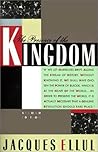
The Presence of the Kingdom by Jacques EllulMy rating: 3 of 5 stars
This book is hard to qualify. It's a work of social criticism, but from a theological angle. The premise is that the Church has lost her savor because she has adopted the elements and ideologies of the world, or been lured into joining them. The answer is to develop an alternate way of life based on the Incarnation and eschaton that both critiques and embraces the world through loving our neighbors (via our daily work, service, prayer etc.) in the power of the Holy Spirit.
It has some of the best insights to the modern situation I've ever read, although it was written over 70 years ago. It is the introductory work of Jacques Ellul and I was left wanting to read more, although it is quite dense. If you read this, do not fail to read the conclusion; it brings together many of the strands that were left dangling in earlier chapters.
Wednesday, March 24, 2021
Learning From Our Elders
A Review of Live Not
By Lies, Rod Dreher, Sentinel Press, 2020
No one would argue that being a Christian in the United
States is easier than almost anywhere else. One of our founding pillars was the
freedom to practice our religion as we see fit and people have migrated for
centuries to enjoy that freedom. Nevertheless, there are changes afoot. Basic
moral codes, understand in the West for thousands of years, are not only being
questioned but mocked and vilified. Under our current legislation, speaking
plainly about what Scripture calls sin can lead to accusation of hate crime.
Big businesses, once protectors of the moral status quo (whether for the right
reasons or not is another matter), now enforce an actively libertine agenda
through their profits and their “training” sessions. Any state who dares to
oppose this risks losing the tax dollars that come from those successful
businesses.
At the time of this writing Kristi Noem, governor of South
Dakota and favorite of social conservatives, just vetoed a bill passed by the
South Dakota legislature that would protect women’s sports to only women. She
admits it was for fear of the NCAA’s potentially negative response to the bill.
This even though the NCAA had yet to address the bill in any form. Just the
thought that South Dakota might face collegiate consequences was enough to
derail a bill Lyndon Johnson would have thought common sense. But Governor Noem
is not alone. Many other red-state, supposedly reliable conservative governors
have capitulated to the woke crowd. As the late columnist Joe Sobran said, “Fool
me once, shame on you. Fool me twice, shame on me. Fool me three times, I'm a
Republican.”
Yet Christians are still free to
practice their beliefs without fear, aren’t they? Yes, but with increasing
limitations. States drunk with power during the COVID crisis shut down churches
because of the health risk while allowing other institutions and rioting
activities to proceed with few precautions. The state of Christian freedom in
the U.S. is not what is used to be. That leads me to the excellent book by Rod
Dreher, Live Not By Lies.
Helpers of Our Joy
Helpers of our Joy: How Humorists Help us See the World in the Light of Eternity What's the point of humorous stories? Some people see t...
-
Hope in Dystopia - Learning from the Christian Humanism of Walter Miller, P.D. James, and C.S. Lewis. While dystopian novels have always bee...
-
A Review of Mortimer Adler's How to Speak How to Listen . New York: Simon and Schuster, 1997. Communication is becoming a lost art....
-
a Review of Norms and Nobility by David V. Hicks One of the lesser-known cries of the Protestant Reformers was, “ Ad fontes ,” which mean...