Helpers of our Joy: How Humorists Help us See the World in the Light of Eternity
"If you instruct the brethren in these things, you will be a good minister of Jesus Christ, nourished in the words of faith and of the good doctrine which you have carefully followed. " - 1 Tim. 4:6
Thursday, August 18, 2022
Helpers of Our Joy
Wednesday, June 29, 2022
Articles and videos for the week
Thursday, September 16, 2021
Hope in Dystopia
Friday, May 7, 2021
Meek and Patient as a Sheathed Sword
The great Romantic poet William Wordsworth wrote many ecclesiastical sonnets, or poems regarding the church. One that affected me recently was titled, "Pastoral Character."
A genial hearth, a hospitable board,
And a refined rusticity, belong
To the neat mansion, where, his flock among,
The learned Pastor dwells, their watchful Lord.
Though meek and patient as a sheathed sword;
Though pride's least lurking thought appear a wrong
To human kind; though peace be on his tongue,
Gentleness in his heart--can earth afford
Such genuine state, pre-eminence so free,
As when, arrayed in Christ's authority,
He from the pulpit lifts his awful hand;
Conjures, implores, and labours all he can
For re-subjecting to divine command
The stubborn spirit of rebellious man?
He begins by expressing the living conditions, "A genial hearth, a hospital board," which show the parson as one who is generous and hospitable to others." He is a type of lord himself, whether or not he actually owns the title, he acts as one who watches over the health and good of those under his care. The picture of one mild-mannered is accurate, but Wordsworth is sure to declare that this man is no weakling, but whose meekness and patience resemble "a sheathed sword." That sword is unsheathed when he climbs the pulpit. He is "arrayed in Christ's authority" and tasked with the responsibility of, through Spirit-inspired words, "re-subjecting to divine command the stubborn spirit of rebellious man."
What a wonderful picture of the man of God!
Monday, May 3, 2021
Thoughts on Romanticism
As I’ve been reading and enjoying the English Romantic poets
recently, I thought I should dig deeper into the metaphysics of Romantic
poetry. This ties in with the appreciation for forms that undergird reality.
That which is real is the basis for what we see and experience.
The best of the Romantic poets and prose artists depict life
through the lens of imagination, which is the key to the Romantic mindset. Sometimes
they portray the best of the past and what we can learn from it, not always the
realistic version. Other times they portray the worst. They offer strong
critique of man’s disregard and corruption of nature and the consequences of
it, be it nominalism, industrialism, or the iconoclastic excesses of the
Reformation.
At its best it presents man in wholeness, mind, body, and
spirit. It portrays life as it should be, both internally and externally. The
consequences of excessive control are presented as harmful, whereas the good
that comes from living in harmony with nature is positive.
On the other hand, the anthropology of Romanticism is overly
optimistic. Believing that original sin is an outward problem that can be fixed
through natural means is faulty. The inward decay of man is at best neglected
and at worst contradicted. This stems from an overemphasis on man being made in
the image of God over and against the belief in man’s depravity. The
imaginative emphasis, so beautifully portrayed in authors like Walter Scott and
Coleridge, is taken to excess in one like Percy Shelley.
Another pitfall among the Romantics is idealism which leads
to ideology. The critique of one (bad) system while demanding implementation of
a (better) system will not lead to wise correction but militant overcorrection.
The example of Procrustes is appropriate here. The perfect ideal becomes the enemy
of the achievable, moderate correction. There is an inherent dualism in play
here. Romantics tend to divided the real from the ideal, focusing only on the
latter and neglecting the former.
The most significant problem with many Romantics is their
atheism. They begin with forms given by God by neglect the One who gave them in
the first place. For these atheists their religion is naturalistic pantheism;
their philosophy then has no real foundation, but the forms are solely their
own individual imaginations. To whatever the imagination is captivated by
natural law, reason, and the Creator, the results are truly beautiful. Once the
imagination is divorced these things, the result may be beautiful on the
surface but underneath is brutal.
Friday, April 23, 2021
New Podcast
Recently I began a new venture in the world of podcasting. I've been hesitant for a while, asking myself if we really need another person talking in cyberspace. But I think there is a need for yet one more podcast.
We are all submerged in the modern world to some extent. We can't and shouldn't try to abandon the world in which we live. Jesus did die for it, after all. If He immersed Himself in the daily matters that surrounded Him, ushering in God's kingdom, we should do likewise.
Slavery has always been a temptation. We understand how selling others into slavery is sin, but we don't understand the problem of giving yourself over to slavery. That's the wisdom of the doctrine of man's natural depravity. Not the straw-man version of depravity, but the realistic teaching that man naturally desires to rule himself rather than submit to God's rule. Ever since Adam and Eve, the serpent has presented the false-story of God-as-tyrant and ____?____-as-deliverer. These potential deliverers can all lead to slavery, whether bad things (drugs, ideology, communist dictators) or good things, e.g. technology, money, etc. A good life is about learning to walk free from the slavery of sin and become a faithful member of God's kingdom.
In this podcast we'll talk to people who understand different aspects of living a good life, whether it's becoming more like Christ, loving our neighbors, growing in wisdom, or being a good steward of the gifts God has given. We will talk about what it means to live free from the oppression of the world and be an agent of God's new creation.
If you're interested, go here...https://mattcarpenter.podbean.com/
Thursday, April 22, 2021
History of American Education
We are bombarded with stories of government
overreach into education. We hear about progressive propaganda disguised as
curriculum, or parents in a California school district who are not allowed
withdraw their children from the LGBT curriculum. You probably did not hear
about the instance in Massachusetts where the state militia arrived at several
homes of families who didn’t want their children to attend the local school.
Under threat of force the militia escorted children from their homes and to the
local school. The reason you probably never heard about it – it happened in
1852. Government overreach and mandatory education go together like Communism
and gulags.
I won’t retread the vast array of problems in modern
education. No one argues that the American education system is sound. But I
will argue that the fruit of our current system is not the result of a good
tree that’s diseased; it is the result of a poor seed planted in thorny ground and
left untended.
The first instruction regarding education was given
by the prophet Moses in the Torah, the first five books of the Bible. These
books represent the first recorded history and culture manual for a nation. He
says that parents were to teach their children to love God at all times of the
day. At a time when parents would spend all day with their children, this was
easily done. Education for the ancients included knowledge, worship, skills,
community-wide activities, and celebrations. Yet we know Israel was not
faithful to that work. When they were captive in Babylon, the synagogues were
created. These were places for worship and instruction in what it meant to be
Jewish.
Skipping ahead a few civilizations, the people known as “the Greeks” were not one synonymous group, but several city-states who differed in what they valued and emphasized. The most notable difference was Sparta, who valued military service and Athens, who valued leisure and intellectual pursuits. Their most famous philosophers: Socrates, Plato, Aristotle, were similar to Hebrew prophets, calling the people to live in a humane way and reject pragmatism (focus on what works, not what’s best) and decadence. They were, like the prophet John the Baptist, voices crying in the wilderness who were mostly rejected by their own people.
Thursday, April 15, 2021
Critiquing the world by loving it
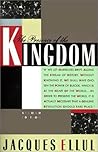
The Presence of the Kingdom by Jacques EllulMy rating: 3 of 5 stars
This book is hard to qualify. It's a work of social criticism, but from a theological angle. The premise is that the Church has lost her savor because she has adopted the elements and ideologies of the world, or been lured into joining them. The answer is to develop an alternate way of life based on the Incarnation and eschaton that both critiques and embraces the world through loving our neighbors (via our daily work, service, prayer etc.) in the power of the Holy Spirit.
It has some of the best insights to the modern situation I've ever read, although it was written over 70 years ago. It is the introductory work of Jacques Ellul and I was left wanting to read more, although it is quite dense. If you read this, do not fail to read the conclusion; it brings together many of the strands that were left dangling in earlier chapters.
Wednesday, March 24, 2021
Learning From Our Elders
A Review of Live Not
By Lies, Rod Dreher, Sentinel Press, 2020
No one would argue that being a Christian in the United
States is easier than almost anywhere else. One of our founding pillars was the
freedom to practice our religion as we see fit and people have migrated for
centuries to enjoy that freedom. Nevertheless, there are changes afoot. Basic
moral codes, understand in the West for thousands of years, are not only being
questioned but mocked and vilified. Under our current legislation, speaking
plainly about what Scripture calls sin can lead to accusation of hate crime.
Big businesses, once protectors of the moral status quo (whether for the right
reasons or not is another matter), now enforce an actively libertine agenda
through their profits and their “training” sessions. Any state who dares to
oppose this risks losing the tax dollars that come from those successful
businesses.
At the time of this writing Kristi Noem, governor of South
Dakota and favorite of social conservatives, just vetoed a bill passed by the
South Dakota legislature that would protect women’s sports to only women. She
admits it was for fear of the NCAA’s potentially negative response to the bill.
This even though the NCAA had yet to address the bill in any form. Just the
thought that South Dakota might face collegiate consequences was enough to
derail a bill Lyndon Johnson would have thought common sense. But Governor Noem
is not alone. Many other red-state, supposedly reliable conservative governors
have capitulated to the woke crowd. As the late columnist Joe Sobran said, “Fool
me once, shame on you. Fool me twice, shame on me. Fool me three times, I'm a
Republican.”
Yet Christians are still free to
practice their beliefs without fear, aren’t they? Yes, but with increasing
limitations. States drunk with power during the COVID crisis shut down churches
because of the health risk while allowing other institutions and rioting
activities to proceed with few precautions. The state of Christian freedom in
the U.S. is not what is used to be. That leads me to the excellent book by Rod
Dreher, Live Not By Lies.
Tuesday, February 23, 2021
More than a Christian Veneer
In the 1990’s Marvin Olasky, editor at World Magazine, began
editing a series of books on Christian worldview. These books included All God’s Children and Blue Suede Shoes,
by Ken Meyers, and State of the Arts,
by Gene Edward Veith (both of which are excellent). Each book in the series approached a topic from a specifically Christian perspective. When I
read Recovering the Lost Tools of
Learning by Douglas Wilson in 2010, it was one of those "light bulb" moments.
Revisiting that book recently, I was reminded why.
I read the book having taught history in a government school
for six years. I knew public education was mostly a farce but could not give a
thorough explanation as to what should be done in response. Certainly I had ideas which I would usually discuss with my carpool companion as we rode to and from work. But they
were essentially to restore rigor and discipline to the classroom. There
was no cohesive philosophy of Christian education, just tweaks to the current
system with plenty of Bible added.
Reading Recovering the Lost Tools of Learning was an oasis for me. The author, Douglas Wilson, not only had ideas of what Christian education should be, he put those ideas into practice. Wilson, longtime pastor of Christ Church in Moscow, Idaho, helped to start Logos School in Moscow. He wanted to start a school that would be more than public education with a Christian veneer. He and the men of the church wanted an education that would nurture the soul. This is best expressed in the words of English poet John Milton. “The end then of learning is to repair the ruins of our first parents by regaining to know God aright, and out of that knowledge to love him, to imitate him, to be like him, as we may the nearest by possessing our souls of true virtue, which being united to the heavenly grace of faith makes up the highest perfection.” That quote summarizes the message of this book.
Tuesday, February 16, 2021
Growing Virtue Through Education
a Review of Norms and Nobility by David V. Hicks
One of the lesser-known cries of the Protestant Reformers
was, “Ad fontes,” which means “back
to the sources.” They were calling upon people to return to the writings of the
Church Fathers when studying theology. The fathers were guides for many who
were leading the Reformation at the time. Recently I decided to go back to a
source that, while not ancient, was instrumental in the rise of the modern
classical education movement: Norms and
Nobility (1981), by David Hicks.
Some books allow for a quick reading and yield their insights without much effort. Not so with Norms and Nobility. Although short, it packs enough wisdom to require multiple, slow readings. Mr. Hicks’ thesis is simple: education will produce some kind of person. Whereas modern education produces utilitarian, empty souls; classical, Christian education aids the formation of virtuous souls. He believes the latter should be the intention of education, as it was in classical Greece, Rome, and the early Christian era. But modern education has abdicated that role in exchange for the diminished role of job preparation. In doing so we have failed the rising generation.
Wednesday, February 10, 2021
Theology of Leaven
Theology of Leaven
Matthew 13:33 “The kingdom of
heaven is like leaven, which a woman took and hid in three measures of meal,
till the whole was leavened.”
Many people read
Rod Dreher’s The Benedict Option and
discussed it afterwards. Many more didn’t read it but criticized it anyway. The
most prominent critique was that he was calling for people to “head for the
hills,” or become Amish. Of course removing yourself and your family from a bad
situation is not always a bad idea, especially if you live in a place where you
will be persecuted for your faith (see Acts 8). But Christians should not be
known as people who only retreat.
That said, retreat is not what Dreher calls for. He calls for strategic training and redeployment. Now that may sound like a mere euphemism for retreat, but in reality it’s a separate plan.
Saturday, January 30, 2021
The Role of Schools in Our Problems
A Review of C.S. Lewis' The Abolition of Man
Years ago when I first picked up C.S. Lewis’ The Abolition of Man, I read a bit of the
first chapter and liked what I read. But as with some of Lewis’ other works, it
gets a bit dense at times. This is not The
Chronicles of Narnia. So I put it down. The book remained on my shelf for
some time I heard it mentioned for the seventh or eighth time by Christian educators.
So I decided to read it all the way through, no matter how dense it was. My reading
was thoroughly rewarded. It is a fascinating look at the world of education through
the eyes of a twentieth century prophet.
The book was written in 1944, with World War Two ongoing. The three lectures that make up the book describe how modern textbooks and teachers insidiously drain the eternal forms of truth, goodness, and beauty from every part of life. This hollowing out of standards supposedly “frees” us to follow our natural instincts, but that freedom is actually a method of enslaving us to the whims of the broader society and its leaders. What those leaders do with their “slaves” in the name of “man’s power over nature” is attempt to forge a society with themselves in complete power. In other words, he explains how the rules of our world try to take over societies through the side door of coercion, rather than the front door of force.
Wednesday, January 27, 2021
Learning to Listen
A Review of Mortimer Adler's How to Speak How to Listen. New York: Simon and Schuster, 1997.
Communication
is becoming a lost art. A mere scan of news channels or one’s Facebook feed
demonstrates that many do not appreciate opposing opinions. Recent books like
Alan Jacob’s How to Think, or Justin
Lee’s Talking Across the Divide
address the difficulty of speaking and listening to those who hold differing
opinions. But communication is more than being polite when someone contradicts
you. It requires thinking, pondering, and gently probing to understand what the
other person is saying. It requires careful consideration of how your own words,
facial expression, and body language will be understood, and striving to use these
methods of expression to appropriately convey your meaning.
Mortimer
Adler understood the importance of communication. His most famous work, How to Read a Book, is a timeless guide to
understanding what we read. In that work he calls the reader to treat a book’s
author like a conversation partner, one whom we should approach with
magnanimity. His advice has helped many students gain a better grasp on
receiving written communication.
Forty
years later he wrote another, less famous book on communication, How to Speak, Hot to Listen. The lessons
presented in How to Speak are no less
important today than they were when he first penned them. Not only does he
present the basics of speaking and listening, he explains the why we should
care about the topic to begin with. This book is for those who are interested
in communication, but he doesn’t stop there. Adler demonstrates how
communication is not the end, but the means to an even greater gift: communion
with others.
The
book begins with two introductory chapters in which he addresses the problem of
communication. The second part of the book explains various methods of public
speaking, e.g. rhetoric, sales speech, lectures, etc. and how one should
prepare for them. These should not be skipped over lightly because one never
knows when it might be necessary to publicly address a group. The third part of
the book explains what Adler calls “silent listening,” or how one should listen
to public speech. He admonishes hearers to listen actively rather than
passively, to carefully consider the message of the speaker and how it applies
to the hearer. Part four discusses communication in day-to-day conversation.
The most notable chapter of that section to me was chapter nine, “Question and
Answer Sessions: Forum”. It details how one should participate when there are
public meetings that allow short question and answer times between individuals.
It is particularly applicable to our social media age, when short posted
statements are often quickly followed by immediate responses. The lessons in
this chapter may seem dated, but are still important.
My
favorite chapter was the last one, where Adler discusses the
connection of conversation to being human. While all mammals communicate in
some fashion, God made man with the ability to have fellowship with others, which
is something the animals can never have. He then refers to Rene Descartes, the
French philosopher who said that man differs from matter primarily because
matter can’t think as man can. To apply this lesson today, artificial
intelligence can only respond as it was programmed to respond. No matter how
detailed it gets, when it is traced back to its origin, those programmed
responses have their origin in man. This differentiation is sorely needed today
in an age when more and more interaction is mechanical. One recent commercial
showed an only child “communicating” with a robot child, and the parents
looking on happily. This exemplifies the problem Adler points out. When the
meaning of human communion through communication is lost, the result is the
confusion in which we live. The first appendix, a lecture given by Adler to the
American Association of Neurological Surgeons, solidly presents further
evidence for why machines can never be truly conversant with people.
Dr.
Adler’s background as a philosopher is evident in his writing (I mean that as a
compliment). As a classical scholar, he uses language to help the reader think
about what writes, not just to score quick rhetorical points or quickly persuade
the reader. This book might be a challenge for some who only want a quick,
self-help book, but it rewards the reader who ponders its meaning. It is
evident that he wants to help the reader grow not only as a communicator but as
a human being. If communication is indeed a means to communion, Adler’s book will
aid all those who pursue that worthy goal.
ow How to Speak
Sunday, January 24, 2021
The Faithfulness of Telemachus
"Be faithful until death, and I will give you the crown of life." - Revelation 2:10
Around Christmas in ancient Rome, thousands had gathered at
the stadium to watch the gladiatorial contests. The bloodlust was strong as the
crowd cheered, not caring as much who won as to see a good fight and abundant
carnage. One man though was appalled. The name Telemachus probably doesn’t mean
much to you; it didn’t mean anything to the crowd. Yet this man, formed in the
desert monastery, had courage forged through the fires of self-denial, daily
prayer, and immersion in Scripture. His virtue was not delicate, but his
conscience thankfully was.
Visiting Rome on pilgrimage, he was sickened by the
murderous games. Seeing the contest he entered the arena and came between the
two fighters, calling upon them to put their swords away. “Do not requite God’s
mercy in turning away the swords of your enemies by murdering each other,” he
said. The crowd turned against the monk, yelling for the battle to continue. He
wouldn’t budge, holding the two apart with his hands. The curses of the crowd
grew, and the gladiators turned against him, killing him before one and all.
The crowed pelted him with rocks, scoffing at the one who would disrupt their
entertainment.
But after witnessing the death of this God-fearing monk,
Rome would never be the same. The testimony of one who would give his life to
stop these games had immediate results. Within a few months of Telemachus’
death the gladiatorial games in the Colosseum ceased. This desert monk of
tender conscience and strong courage was used by God to accomplish much.
Thursday, January 21, 2021
A Renewed Perspective of Education
A Review of Dorothy Sayers' Essay, "The Lost Tools of Learning"
For generations the education
system has been floundering. Having followed the methods of John Dewey and the
mechanical philosophy of Frederick Taylor, public schools are a bureaucratic
mass measured by test performance and the ability to inculcate the latest
social ideas. Countless parents know there are problems but do not know how to
address them. Many educators know that the system is failing to provide
students with what they need but have grown apathetic after years of striving
within the system. Where is the hope for educating our children when such
conditions exist and the system itself seems to be on an endless downward
spiral?
Dorothy Sayers’ essay, “The Lost Tools of Learning,” is timelier today than it was when it was written in 1947. The problems she identified then seem only to have multiplied in the more than sixty years hence. Students have greater access to knowledge today than they did in medieval times yet foolishness abounds. There is a world of information available through technology, but no wisdom as to how and when it should be used. And as Mrs. Sayers so aptly expressed in her essay, “Is it not the great defect of our education to-day… that although we often succeed in teaching our pupils "subjects," we fail lamentably on the whole in teaching them how to think?”
Tuesday, January 19, 2021
Living In A Technocratic Economy
- Vary your technological presence among more than one or two forms. Don't just rely on Youtube or Facebook. Spread it out a bit.
- Be wise in what you post. There are many situations that are simply not our business and nothing will change if we say something or say nothing, so say nothing (Prov. 26:17). Don't put yourself at useless risk.
- Pursue business platforms that appreciate your convictions. You should already know the major social media platforms and banks hate your convictions; while this may not matter as long as you don't rely on them too much for income, the bigger you get, the more it will hurt if they come after you. Therefore begin with someone who can meet your needs but won't throw you under the bus because of what you believe.
Establishing Habits
This is the second part of a personal finance lecture on goals and habits.
Goals must have an action plan, a method of putting the steps towards achieving that goal into practice. In our traveling case, the action plan were the roads we’ve travel to get where we wanted to be at the end of each day. This leads us into the discussion of habits.
I’m taking much of this from the book, Atomic Habits, by James Clear. It is the best book I’ve read about
habits and the effects they have on people.
People often confuse goals and habits. Forming particular
habits can be a goal, but good habits should not be temporary things we attempt
and let go of, but permanent changes we make that form character. Aristotle
refers to the four cardinal virtues as types of habits, things we must be
formed in. But developing good habits is not easy. So if you set large habits
it may not be attainable immediately. You should aim for smaller, more permanent
habits (hence the name, atomic, i.e. atom-like” habits). These will remain with
you. The author, James Clear, emphasizes the nature of compound interest when
considering habits. Compound interest is the interest that builds up over time,
months, and years. When we build smaller habits over time, they form larger
patterns in our lives and give us the ability to achieve our goals.
“Small changes often appear to make no difference until you
cross a critical threshold. The most powerful outcomes of any compounding
process are delayed. You need to be patient.” (Atomic Habits, ch. 1). Also in
chapter 1, he says, “You do not rise to the level of your goals. You fall to
the level of your systems.” In other words, you must have a system or a process
in place to bring about your goals. He even says that goals are a waste of
time, which I disagree with, but I understand what he’s saying. There must be a
plan to accomplish the goals, and then there must be further goals to pursue
them.
As your habits change, you will change. You will find that
your outlook improves and you will grow in confidence. This is not immediate
but happens as you stick with your habits. Which leads to another point – you
must be willing to grow, to change. Jesus commended humility in what we know as
the Beatitudes (Matthew 5:1-12), e.g. “blessed are the poor in Spirit, blessed
are the meek…” These qualities are born in the person who is sees his or her
life as being in God’s hands and is willing to submit his life to the direction
God gives.
We all have areas in which we need to grow. Willingness to
give yourself to godly habits and change is necessary to become the person He
intends you to be. Never become locked into thoughts or a mindset except what
is commanded by God in His word. Commit yourself to growth throughout your
life.
There is much more we could say about habits, but let me tie
this together with personal finance. In time we will come to discussing God
calls us to be good stewards of our finances, i.e. saving and building. But
having more money isn’t the end of life. Solomon said in Ecclesiastes that the
rich only end up leaving their money to others (Eccl. 5:10-17). We begin this
semester by considering how we are to arrive at the destination before us. But
if your destination if faulty, all the planning in the world will only get you
to perdition faster. This goes back to your reason for building wealth. If you
see yourself as a steward in God’s kingdom and everything you have as a gift
from Him, you will be more likely to pursue the gifts of God but to do so as a
soldier, living as a minister of God’s restoration in the world.
Thursday, January 14, 2021
Setting Goals
This is the first portion of a lecture I delivered on goals and habits.
Time is precious. Your time is marked when you’re young by holidays, usually Christmas or birthdays. As you grow older, those markers become more closely aligned, because you have more years behind you. As you grow, your memories collapse together. The question is, what will you do with your time?
Time is a gift, just as any other type of wealth. Every
person is allotted 24 hours in a day, 365 ¼ days a year. Why do some people
accomplish more than others? Because of the way they use time. If you are lazy,
you will not accomplish as much. On the other hand, others follow the tyranny
of the urgent, only doing the things that are in front of them, rather than
investing your time beforehand. Don be that person either. We are called to
invest, to be good stewards of our time. This doesn’t mean we only work all
day, every day. It means we plan beforehand for how we will spend our time. ‘
One of the saddest things to hear is someone who is older
who regrets wasting their time on their daily job, their bad habits, or selfish
behavior. It is not possible to have everything you want; scarcity is still
with us. But God has given you gifts, abilities, wealth, and time to use those
things.
Your life is not your own. Throughout your life there will
be stops, starts, energy, and lack thereof. Yet in everything, God controls
your life. You belong to Him and He calls you to use your gifts to honor Him.
The direction of your life is largely in front of you. You
have a multitude of options available, based on your gifts or skills. The
choices you make in the next several years will determine the path you follow,
the person you marry, and the eulogy that will read about you at your funeral.
We will talk about those choices soon, but this week we must
consider the first objective: setting goals and building habits. A goal is not
just a task, but a building-block to the type of person you want to become.
Years ago, when our family moved out to Idaho, the trip took 36 hours of
driving, not including stops. Our final destination was Lewiston, Idaho, but
there had to be planning beforehand. I planned four stops along the way. We
would stay there each night and go the next morning. I realized my planning was
not thorough enough because one of the stops, Denver, CO, unbeknownst to me,
had three major events going on and every hotel within a 1-hour radius of the
city was booked. We ended up driving until almost 1:30 in the morning and
staying 1 and ½ hours further north.
You should have one or two final goals, the things you want
to do with your life, which will probably resemble the final goal of others.
But the stops along the way will be different for each of you, based on where
you are. The stops along the way are your goals now. I thought Lewiston might
be a long-term place for us to live, but it turned out that we only lived there
two years. Then we repeated the trip back, although to a different place in
Alabama. Your life will change and you will have to adapt at times, but your
goals are still attainable.
Why set goals? They require you to set a destination. You’ve
probably hear the saying, “If you aim at nothing, you’ll hit it every time.”
That is true. There must be something you want to achieve.
They must be goals that motivate you. You won’t pursue them
if they don’t. It will probably be something that you appreciate or want to
become.
They should be SMART (https://www.mindtools.com/pages/article/newHTE_90.htm).
Specific – they must be clear, not vague. For example, when
we traveled instead of saying, “Denver, CO,” I should have said, “The Holiday
Inn Express at 123 Johnson Street in Denver.”
Measurable – you must know how you can determine whether or
not you met the goal.
Attainable – if it is not within your reach in the time you
set, you will get discouraged and be more tempted to quit.
Relevant – they should be in the service of the general
direction you want to go. If we were travelling from Alabama to Idaho, we
shouldn’t set a goal of stopping in Maine. It’s not relevant to our main goal.
Time Bound – there should be a specific time you plan on
achieving your goal. If not, you will flounder. We planned on driving
approximately 9-10 hours each day on our trip west. Establishing a time (create
a website in 6 months) puts you under the gun.
Finally, they must have an action plan, a method of putting the steps towards achieving that goal into practice. In our traveling case, the action plan were the roads we’ve travel to get where we wanted to be at the end of each day.
Friday, January 8, 2021
The Lord of Armies
"The Lord of hosts is with us, the God of Jacob is our refuge." Psalm 46:7
It is common in Scripture to see the name "Lord of hosts," ascribed to God. It means "Lord of armies," as in, the armies of heaven and earth (Daniel 4:35). God's people were always a small nation when compared to the others surrounding them. Though they had an army in the time of the kings (Saul, David, etc.), they had to rely on God for deliverance. It was only by relying on Him that they were able to win in battle. You regularly see them victorious when they humbly seek God in prayer first, and usually defeated when they rely on the arm of man alone. It was always the Lord of armies who gave them victory in battle.
It became even more important to trust in Yahweh's protection after they returned from exile in Babylon, and that is exactly when you see this name for God come into much more common use. When God's people returned to their homeland, they had no standing army. They were under the dominion of Persia, sort of a colony. If they faced attack from outside, they had no earthly king who would lead them into battle. They had to rely on the Lord of armies to defeat their enemies. This didn't mean they would not fight (see the story of Esther), but there was no main leader to whom they could trust. It was either God or no one.
I thought about this recently after the events of this past week: Republicans lost in Georgia, giving the Presidency, the U.S. House, and Senate all to a political party who seeks to increasingly restrict the voice of orthodox Christians from all spheres of life. This is in addition to the decades-long push by the largest businesses in the U.S. to pull down all opposition to the ongoing techno-sexual revolution. The icing on the cake this week was the mob invading the U.S. Capitol building, and the association of those clowns with anyone who opposes the incoming President and his party.
Before the special Georgia election, some (including me) said that surely at least one Republican would be elected and at least the Senate would be able to block the garbage from the House. But no, there is now no block. Even then, aside from judges, how much good have the so-called "good guys" done when they controlled the Presidency, House, and Senate? Might our hopes have been put in the wrong thing?
God's people in the United States need to learn what our brethren in Nigeria, China, and Iran have known for a long time: our only help comes from the Lord of hosts. Certainly we should pursue the election of godly leaders, men and women who will lead in justice, mercy, and humility, who will speak out against technocracy, sexual perversion, and stand/fight for truth. But never forget that our deliverance, our protection, and our victory belongs to the Lord of hosts.
When we're tempted to become cynical, to despair, and put our heads down, remember He who fights for us is greater than the forces who oppose us. Men have and will fail at times - therefore we don't put our ultimate hope in men. We might not see all our allies, but in God's cosmic commonwealth, the opposition is at His mercy. In the meantime we continue working, praying, standing upright, and pursuing the ground before us. All the while remembering that no matter what happens, the Lord of armies is our defense.
Helpers of Our Joy
Helpers of our Joy: How Humorists Help us See the World in the Light of Eternity What's the point of humorous stories? Some people see t...
-
Hope in Dystopia - Learning from the Christian Humanism of Walter Miller, P.D. James, and C.S. Lewis. While dystopian novels have always bee...
-
A Review of Mortimer Adler's How to Speak How to Listen . New York: Simon and Schuster, 1997. Communication is becoming a lost art....
-
a Review of Norms and Nobility by David V. Hicks One of the lesser-known cries of the Protestant Reformers was, “ Ad fontes ,” which mean...